Perception Technologies for
Physical AI

Advanced sensing hardware and algorithms for embodied robots and automonous systems.


Explore Tech

Industrial Solutions

Translating complex sensory data into actionable physical intelligence across mission-critical industries.

Humanoid Robotics
Embodied AI

Humanoid Robotics

Deploying multi-modal eSkin in healthcare robotics for safe, high-precision tactile interaction.

Smart Mobility
Automotive

Smart Mobility

High-frequency IMU fusion and kinetic analysis for next-gen electric vehicle navigation.

Industrial IoT
Industry 4.0

Industrial IoT

Cloud-edge collaborative sensing and real-time condition monitoring for smart manufacturing.

Product Spotlight

PCT-IMU-160 High-Performance AHRS

Ultra‑compact · High cost‑performance · Attitude and Heading Reference System
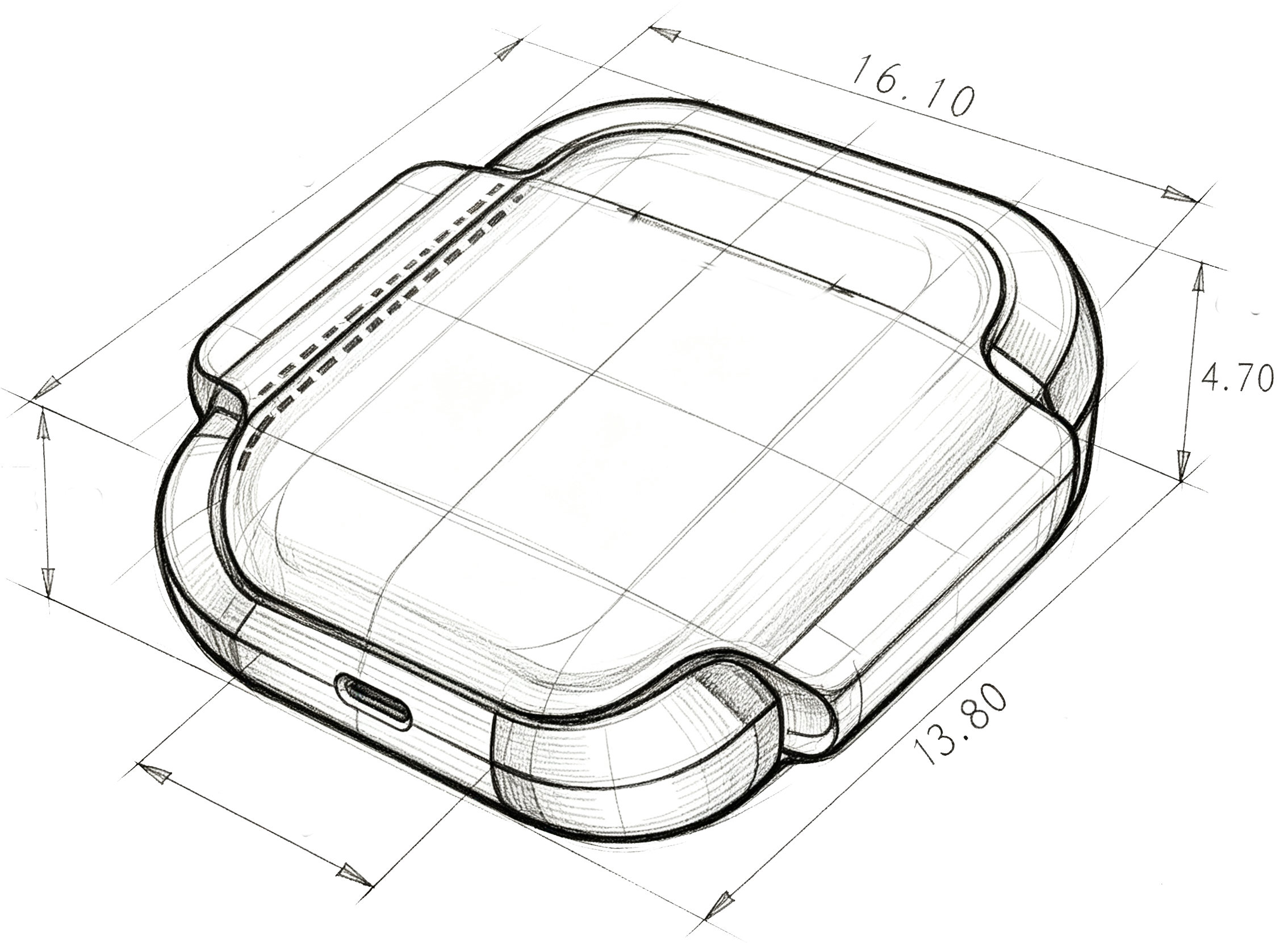
PCT-IMU-160 product sketch

The PCT‑IMU‑160 is a high‑precision attitude sensor developed specifically for embodied intelligent robots, integrating a proprietary fast‑calibration algorithm and anti‑interference algorithm. It is calibrated using aerospace‑grade turntables before delivery and intelligently eliminates cross‑axis errors after installation. It can be periodically self‑calibrated on‑site without returning to the factory, providing accurate attitude data even in extremely complex environments. It features IAP upgrade capability for firmware updates during operation.

0.1° Heading accuracy / revolution
0.05° Pitch / Roll accuracy
1000Hz Max output frequency
16.1×13.8×4.7mm Ultra‑compact size
-40°C ~ +85°C Full temperature range operation

6‑axis IMU Intelligent Fusion

Six‑axis sensor data fusion algorithm delivers real‑time high‑precision heading, pitch and roll attitude.

Ultra‑High Precision

Heading ≤0.1°/rev, pitch/roll ≤0.05° (static), meeting the most demanding application requirements.

AEC‑Q100 Automotive‑Grade

Qualified to AEC‑Q100, compliant with automotive electronics reliability standards for vehicular and industrial use.

CNAS Traceable Accuracy

Accuracy traceable to CNAS, calibrated on aerospace‑grade turntables before delivery for trustworthy data.

Full‑Temperature Compensation

Compensated across ‑40°C ~ +85°C, maintaining stable output under extreme temperature conditions.

ISO 26262 Functional Safety

Automotive‑grade functional safety certification, providing reliable protection for safety‑critical applications.

Technical Specifications

Supply voltage 5V DC
Operating current 80 mA
Operating temperature ‑40°C ~ +85°C
Storage temperature ‑55°C ~ +100°C
Output frequency Up to 1000 Hz
Interface CAN / CAN FD
Dimensions (L×W×H) 16.1 × 13.8 × 4.7 mm
Weight ≈ 1.5 g
Housing material Magnesium‑aluminium alloy, anodised

Applications

Humanoid robots Rotor UAVs Quadruped robots Dexterous hands Motion capture Low‑speed unmanned vehicles Observation & aiming devices Fixed‑wing UAVs
Humanoid robot
Quadruped robot
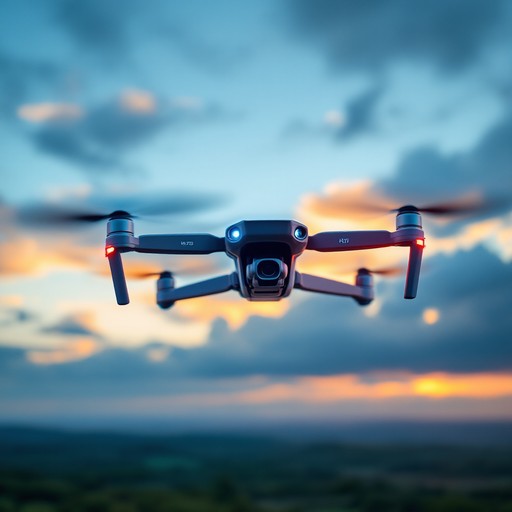
Drone / UAV
Robot motion / dexterous hand
Humanoid robot walking / motion capture

Supports IAP online firmware upgrade · Built‑in fast calibration & anti‑interference algorithms
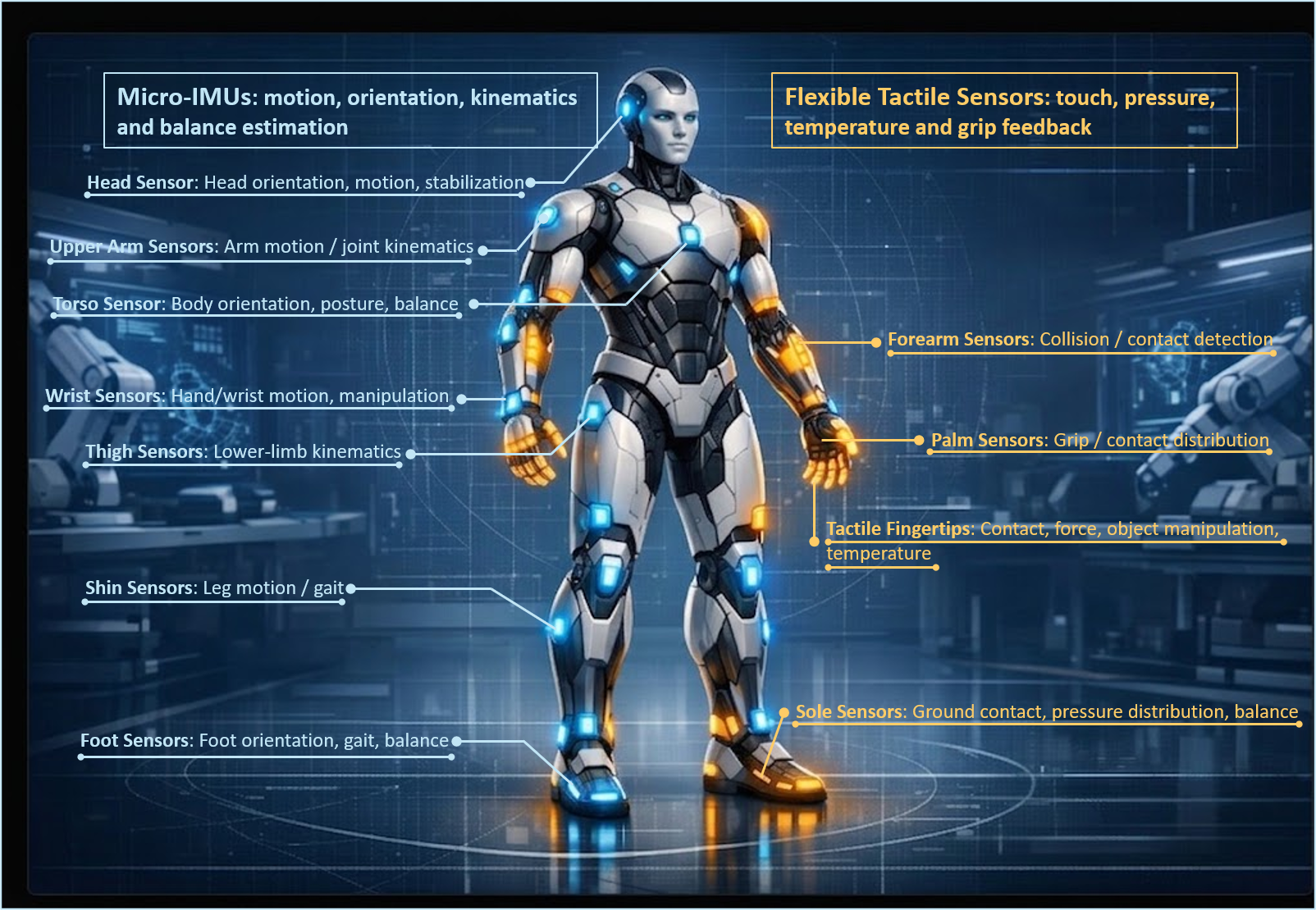
Application Scenario

Humanoid application scenario

Industrial Robots

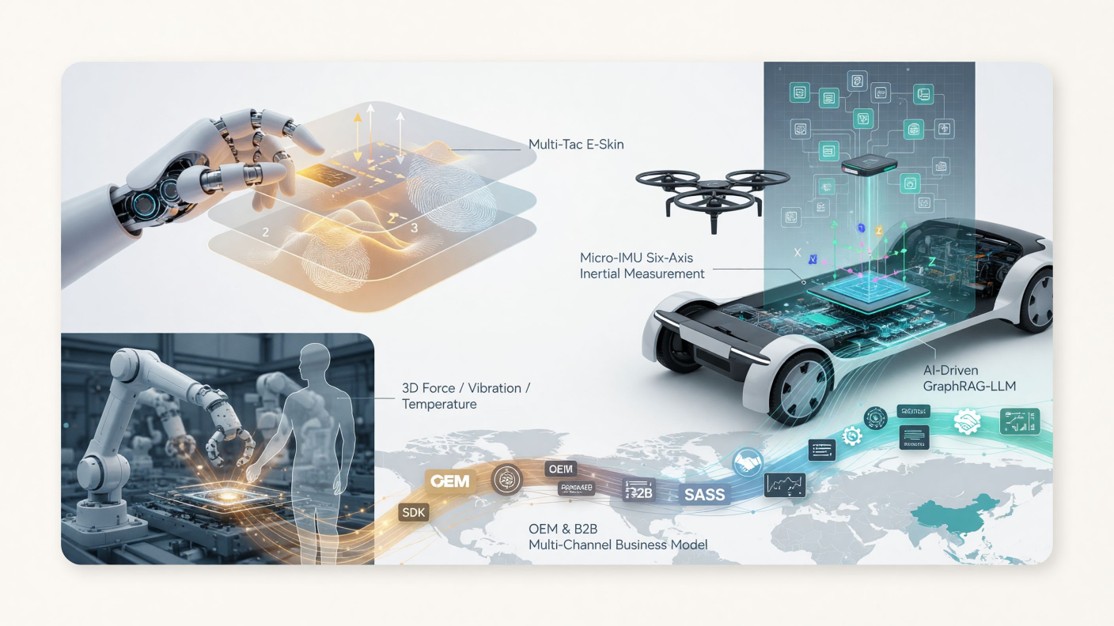
Industrial robots gain enhanced dexterity and safe human-robot collaboration through multi-modal tactile feedback.

Autonomous Electric Vehicles

Micro-IMUs enable six-axis precision navigation and control for autonomous and low-altitude electric vehicles.

Sensor Design and Manufacturing Platform

GraphRAG-LLM merges graph-based retrieval and LLM for optimized sensor design and manufacturing.
Global Network

Technology Stack

From nanomaterial sensing to hardware-accelerated cognition.

Hardware

Multi-Modal Tactile Sensor

Multi-Tac E-Skin integrates flexible thin-film layers for simultaneous force, vibration, and temperature sensing.

Next-Generation Micro-IMU

Next-generation micro-IMU features dual-layer design combining 3D structure and single-chip six-axis integration.

GraphRAG-LLM AI Platform

GraphRAG-LLM merges graph-based retrieval and LLM for optimized sensor design and manufacturing.

Intellectual Property & Research

Patents, publications, and funded projects driving our sensing innovation.

15+

Patents Filed

100+

Publications

50+

Funded Projects

Patents

Granted & filed patents covering tactile sensing, MEMS, and wearable technologies

Publications

Peer-reviewed papers on E‑Skin, tactile sensing, and Micro‑IMU research

Funded Projects

Government and industry grants driving our R&D forward

Research and innovation lab

Granted & Filed Patents

  • US11,971,951B2 – "Systems and Methods Using a Wearable Sensor for Sports Action Recognition and Assessment" (granted 30 Apr 2024)
  • US7,508,384B2 – "Ubiquitous 3D Digital Pen Using MEMS Motion Sensing Technology" (granted 24 Mar 2009)
  • US5,905,007 – "A Method for Aligning and Forming MEMS on Contouring Surfaces" (granted 18 Mar 1999)
  • 64/048,559 – "Flexible Mechanoluminescence Tactile Sensor with High Sensitivity and Spatial Mapping" (filed 24 Apr 2026)
  • 63/975,523 – "System and Method for Material Identification Using Thermal Tactile Sensor" (priority 2026)
  • 19/356,810 – "Robotic Tactile Skin Material with Self-Decoupled Dual-Modal Sensing Ability" (priority 2025)
  • 18/896,030 – "Substrate Materials for Epidermal Use" (pub. US20260083873A1, 26 Mar 2026)
  • 63/959,310 – "Wearable Flexible Tactile Sensor with Fingerprint Patterns" (filed 13 Jan 2026)
  • 19/533,845 – "Tactile Pressure Sensor and Method of Formation" (filed 09 Feb 2026)

E‑Skin & Tactile Sensing Publications

  • Yu Feng et al., "Intrinsic Force-Temperature Self-Decoupling Enables Human-Like Tactile Sensing in a Soft Ionic Skin," ACS Nano (2026).
  • Yu Feng et al., "A Soft Mechanoluminescent Skin for High‐Resolution Optical Tactile Sensing," Advanced Science (2026).
  • Jianfei Wang et al., "A Wearable AI-Driven Mask with Humidity-Sensing Respiratory Microphone," Advanced Science (2025).
  • Jiao Suo et al., "AI‐enabled soft sensing array for simultaneous detection of muscle deformation and mechanomyography," Advanced Science 11(16), 2305025 (2024).
  • Jiao Suo et al., "Enabling Natural Human-Computer Interaction Through AI-Powered Nanocomposite IoT Throat Vibration Sensor," IEEE IoT J. (Apr 2024).
  • Yu Feng et al., "Amoeba-Inspired Self-Healing Electronic Slime for Adaptable Epidermal Wearables," Adv. Funct. Mater. 34(37), 2402393 (2024).
  • Jiao Suo et al., "Wide‐Bandwidth Nanocomposite‐Sensor Integrated Smart Mask for Tracking Multiphase Respiratory Activities," Adv. Sci. 9(31), 2203565 (2022).
  • Kuanming Yao et al., "Encoding of tactile information in hand via skin-integrated wireless haptic interface," Nat. Mach. Intell. 4(10), 893–903 (2022).
  • K. W. Kong et al., "Sphygmopalpation Using Tactile Robotic Fingers Reveals Fundamental Arterial Pulse Patterns," IEEE Access 10, 12252–12261 (2022).
  • T. Mei et al., "An integrated MEMS three-dimensional tactile sensor with large force range," Sens. Actuators A <80(2), 155–162 (2000).
  • Li, WJ, Mai, JD & Ho, C-M, "Sensors and actuators on non-planar substrates," Sens. Actuators A 73(1-2), 80-88 (1999).

Micro‑IMU & Motion Sensing Publications

  • Hongyu Zhang et al., "Assessing Sarcopenia-Prone Risk through Daily Activity of Gait with AI-Powered Wearable IoT Sensors," IEEE IoT J. 12(12), 20301–20313 (2025).
  • Keer Wang et al., "Machine Learning-Based Early Detection of Sarcopenia-prone Risk Using Five-Time Sit-to-Stand Test Analysis," IEEE IoT J. (2025).
  • Meng Chen et al., "Phase-based quantification of sports performance metrics using a smart IoT sensor," IEEE IoT J. 10(18), 15900–15911 (2023).
  • Yuliang Zhao et al., "A Single Smart Ring for Monitoring 20 Kinds of Multi-Intensity Daily Activities," Adv. Intell. Syst. (Oct 2022).
  • M. Chen et al., "Wireless AI-Powered IoT Sensors for Laboratory Mice Behavior Recognition," IEEE IoT J. 9(3), 1899–1912 (2022).
  • Yufan Wang et al., "IoT for Next-Generation Racket Sports Training," IEEE IoT J. 5<(6), 4558–4566 (2018).
  • Y. Wang et al., "Volleyball Skill Assessment Using a Single Wearable Micro Inertial Measurement Unit at Wrist," IEEE Access 6, 13758–13765 (2018).
  • S. Zhou et al., "Hand-writing motion tracking with vision-inertial sensor fusion," Sensors 14(9), 15641–15657 (2014).
  • Zhou et al., "2D human gesture tracking and recognition by the fusion of MEMS inertial and vision sensors," IEEE Sens. J. 14, 1160–1170 (2014). (Top 50 most downloaded papers in Oct 2014)
  • S. Xu, S. Zhou, and W. J. Li, "MEMS accelerometer based nonspecific-user hand gesture recognition," IEEE Sens. J. 12(5), 1166–1173 (2012). (Top 25 downloaded Apr–Sep 2012)
  • G. Shi et al., "Mobile Human Airbag System for Fall Protection Using MEMS Sensors and Embedded SVM Classifier," IEEE Sens. J. 9(5), 495–503 (2009).
  • W. J. Li et al., "A micropolysilicon high-angular-rate sensor with off-chip wireless transmission," Sens. Actuators A <89(1–2), 56–63 (2001).

Funded Research Projects (Selected)

  • RAISe+ Scheme (HKSAR) – "Industrial-Scale Intelligent Sensor Commercialization Using Synergistic Generative Micro-Nano Manufacturing Platform" (2026–2029)
  • NSFC-RGC Collaborative Research – "Advancing Multimodal AI Endoscopic Robots for Next-Generation Colon Diagnosis and Treatment" (2026–2030)
  • Hong Kong Sports Institute – "AI Wearable Micro Data-Logger for Motion Tracking and Performance Analytics – Swimming" (2023–2025)
  • Hong Kong Sports Institute – "AI Wearable Wireless Micro Motes for Real-Time Motion Analytics of Gymnastics and Wushu Athletes" (2022–2024)
  • Hong Kong General Research Fund – "A Flexible Sponge-based Vibration Sensor for Conversion of Neck-skin Vibration to Digital Voice" (CityU 11207222, 2023–2025)
  • RGC Theme-based Research Scheme – "Intelligent Robotics for Elderly Assistance in Hong Kong" (T42-717/20-R, 2021–2026)
  • JLFS - RGC Joint Laboratory – "Development of 3D Integrated Robotics and Sensing Structures using Multi-layered Nano-ink Circuit Deposition" (JLFS/E-104/18, 2019–2022)
  • ITF University-Industry Collaboration – "An Implantable Micro-Sensing System for Tracking Animal Motion Behaviors" (UM/326, 2017–2019)
  • NSFC/RGC Joint Research – "Programmable and Integrated Fabrication of Nano-material Devices by Optically-Induced Force Field" (N_CityU132/14, 2015–2018)
  • ITF Green Motion Sensors – "Graphene-based Eco-Friendly Micro Accelerometers" (ITS/143/13, 2013–2015)
  • RGC General Research Fund – "Automated Fabrication of Bio-Polymer Structures by Optically-Induced Dielectrophoresis" (CityU 116912, 2012–2014)
  • ASTRI Research Contract – "3D Human Gesture Tracking based on Micro-IMU and Vision Sensor Fusion" (9211037, 2012)
  • ASTRI Consultancy – "Motion Sensor MMI Technology" (ARD/038, 2008–2010)
  • ITF – "Development of MEMS-based uIMU for Life-Saving Applications" (GHP/029/06, 2007–2009)
  • RGC Grant – "Fabrication of CMOS-Integrated Carbon Nanotube Sensors by DEP and Nano-Spotting Technologies" (413906, 2006–2009)
  • ITF – "Development of Ultra-Low-Power Alcohol Vapor Sensors Based on Functionalized CNT Sensing Elements" (ITS/027/06, 2006–2007)
  • RGC Grant – "Fabrication of Carbon Nanotube Sensor Arrays Using Robotic Micro-injection and DEP" (CUHK4177/04E, 2004–2006)
  • National 863 Plan – "Polymer-Based MEMS Devices for Cellular Manipulation and Sensing" (2002AA431620, 2002–2004)
  • RGC Earmarked Grant – "A Force and Impact Sensing System for Robotic Micro-assembly" (CUHK 4381/02, 2002–2005)
  • ITF – "Eco-safe Human-motion-powered MEMS Energy Generator for Mobile Electronic Devices" (ITS/185/01, 2002–2004)
  • ITEP Grant – "Wireless Network Micro Sensors" (6900916, 1999–2001)